Photo-aging protection testing overview
Do you provide Photo-aging protection testing?
Photo-aging protection testing under a controlled UV challenge
Repeated UV exposure is the main external driver of skin ageing. UVA reaches the dermis and generates reactive oxygen species, UVB acts mainly on the epidermis and damages DNA directly, and both raise MMP levels that break down collagen. A photo-ageing study recreates that sequence in the laboratory and measures how far a test product reduces each step.
Irradiation set-up
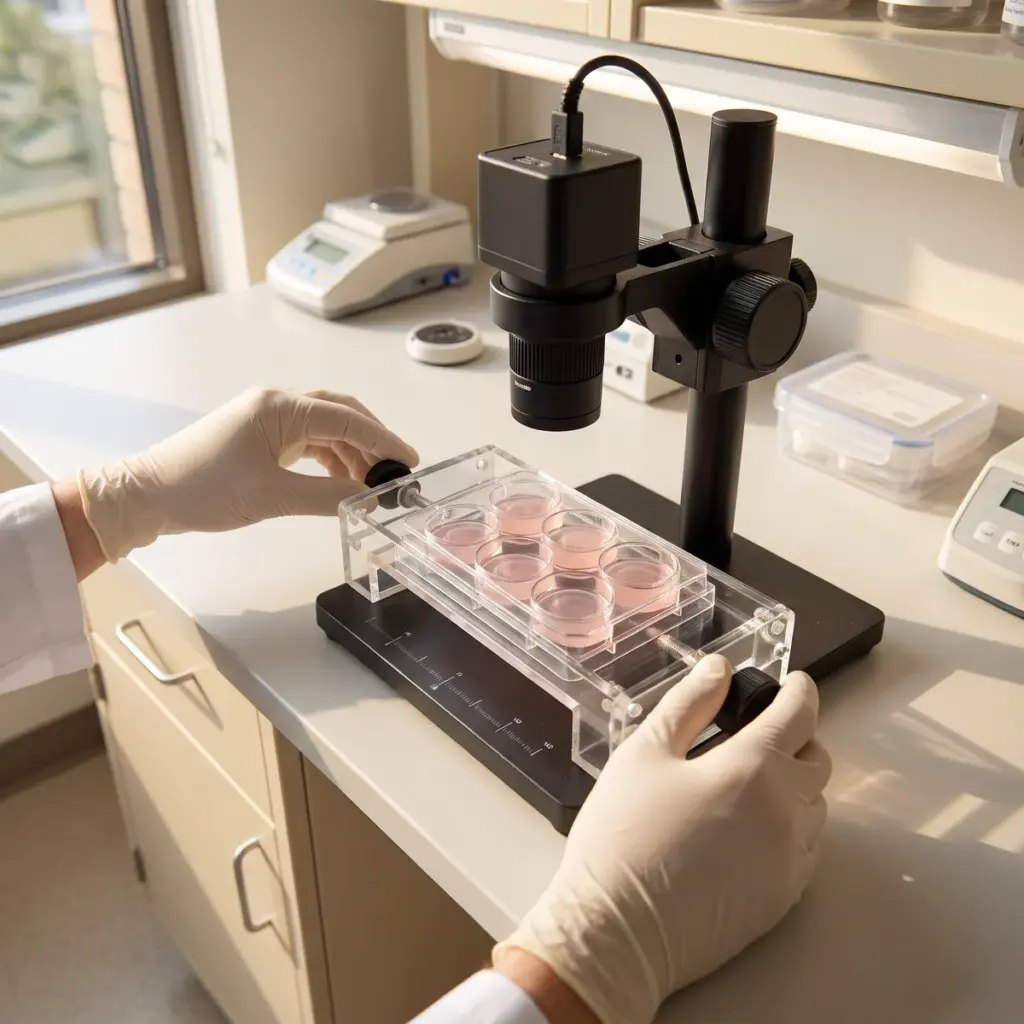
Fibroblasts, keratinocytes, reconstructed skin or human skin explants are pre-treated with the test material, then exposed to a solar simulator or UV lamp. The spectrum, irradiance and dose are measured with a calibrated radiometer and reported. Each run includes non-irradiated, irradiated vehicle and reference antioxidant controls.
Endpoints after exposure
- Cell viability after irradiation
- Intracellular reactive oxygen species and lipid peroxidation
- Cyclobutane pyrimidine dimers and other DNA damage markers
- Sunburn cells in reconstructed skin or explants
- Inflammatory mediators such as IL-1α, IL-6 and PGE2
- MMP-1 induction and procollagen levels
Formula photostability
As a separate module, the laboratory can irradiate the formula itself and measure how much of the active remains, along with colour and texture changes. This tells you whether the active survives light exposure in the pack and on skin.
UV dosimetry and irradiated-control comparisons
The report gives UV source characteristics and dosimetry, then each endpoint as a percentage of the irradiated control, with statistics, dose-response data and representative images from tissue models.
How brands use photo-aging protection data
UV challenge results let a daily-wear product show what its antioxidants and repair actives do once light reaches the skin.
Positioning a daily protection product
Photo-ageing data support mechanism claims such as reduced UV-induced oxidative stress or protection of collagen in UV-exposed skin models. They work alongside a product’s SPF and UVA rating, which come from separate standardised sun protection tests. A day cream with sunscreen can carry both: the SPF for the filter system and the photo-ageing data for antioxidants or repair actives in the formula.
Choosing a provider for UV work
Dosimetry quality decides how reproducible your results are. Ask what light source the laboratory uses, how often it is calibrated and whether the spectrum can be filtered to UVA only or full solar. For tissue claims, check that they run reconstructed skin or explants under irradiation and can score sunburn cells and DNA damage by immunostaining. Labs that also offer blue light or infrared exposure are useful if your claim covers wider light ranges.
Combining with matrix studies
UV-induced collagen loss runs largely through MMPs. If the active works on that step, a dedicated MMP inhibition study adds enzyme-level data. Actives that also reduce cellular ageing markers after repeated UV exposure can be followed up with senescence reduction testing.
More in ECM & Skin Ageing
ECM & Skin Ageing testing measures how actives affect collagen, elastin, matrix enzymes, glycation and senescence in skin cell and tissue models.