Cosmetic quality, stability and preservation testing


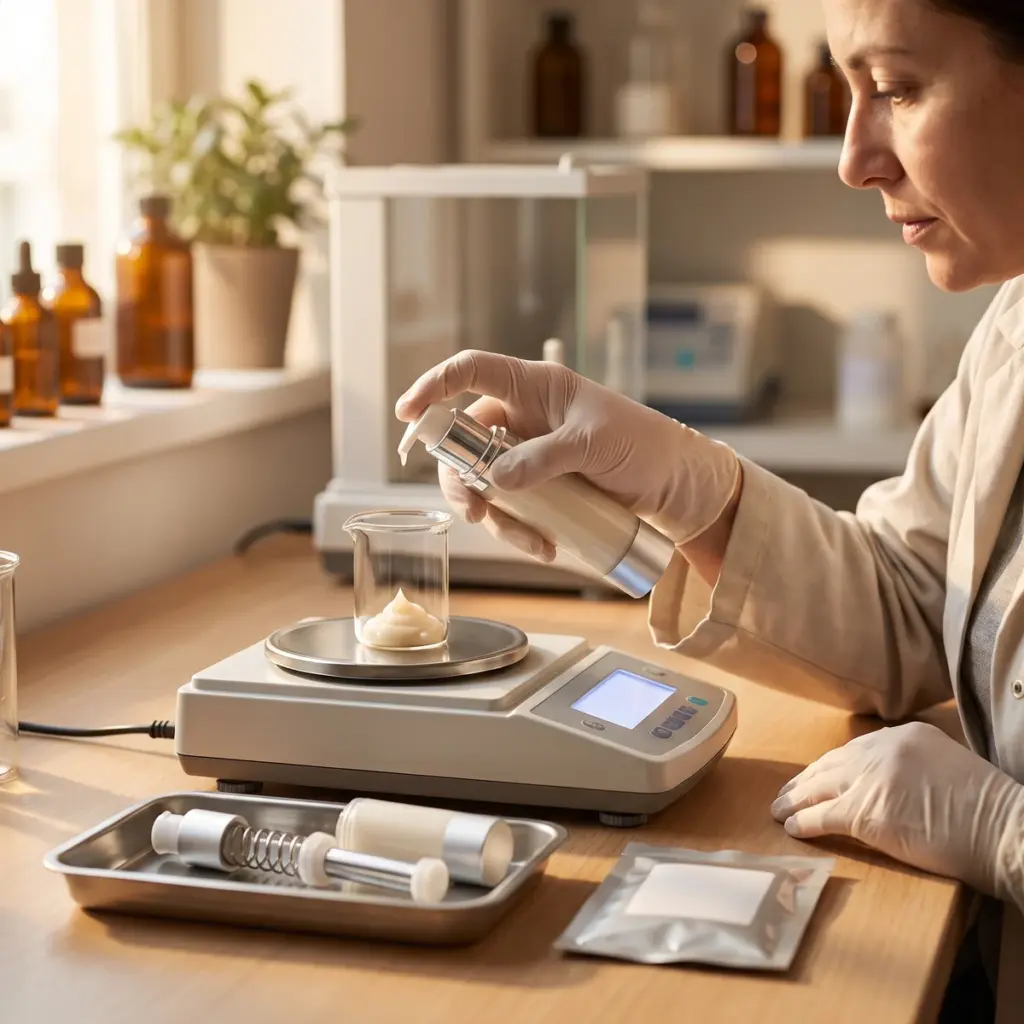
Cosmetic Quality Testing overview
Who provides Cosmetic Quality Testing
Companies providing Cosmetic Quality Testing

Cosmetic quality, stability and preservation testing by discipline
The family splits into five groups of services, each built on its own instruments and expertise. Most product programmes draw on several of them.
Composition and physical properties
Physicochemical testing measures what is in the formula and how it is built: active content by chromatography, pH, viscosity, particle or droplet size, microstructure under the microscope and spectroscopic fingerprints. These are the numbers that go into a finished-product specification.
Feel, appearance and application
Texture and colour testing uses texture analysers, spreadability rigs and spectrophotometers to put figures on firmness, glide, applicator transfer and shade. It is the quality side of sensory work, used to match batches to a reference.
Ingredient delivery into skin
Skin absorption studies follow an ingredient after application, with Franz diffusion cells, tape stripping and separation of skin layers. They show how much reaches the stratum corneum, epidermis or receptor fluid, and how the formula changes that.
Microbiology and preservation
Microbiological testing covers contamination counts on finished batches and challenge testing of the preservative system, where the product is inoculated with bacteria, yeast and mould and the reduction is counted over several weeks.
Stability and packaging
Stability and packaging compatibility studies store the product in its final pack at raised temperature, through freeze-thaw cycles and under light, then check the formula and the container for change. Their results set the shelf life and period after opening.
Services in Cosmetic Quality Testing
Skin Absorption Studies
Stability & Packaging Compatibility
Building a cosmetic quality testing plan around your launch
The order matters more than the number of tests. A typical new product moves through three stages.
During development
Physicochemical and texture measurements compare prototypes and give the formulator targets. Absorption work comes in here when the product’s positioning depends on an active reaching a particular skin layer.
Before launch
The chosen formula goes into stability and packaging compatibility testing in its final pack, alongside a preservative challenge test. These two studies supply the evidence a safety assessor needs to sign off the product, and the stability data sets the date you print on the label. Plan them first, since they take the longest.
In production
Release testing checks each batch against the specification for appearance, pH, viscosity and microbial counts. When a batch fails or a stored product separates, the same physicochemical and microbiological methods are used to trace the cause.
For a single provider, look for a laboratory that runs both microbiology and stability chambers, since the two studies share samples and timelines. Product claims about skin tolerance belong to cosmetic safety testing, a separate group of services.
More in Quality & Safety
Quality and safety services test a cosmetic’s stability, microbiology and composition, and assess its safety for consumers before market release.