Pilot-to-Industrial Scale-Up



Pilot-to-Industrial Scale-Up overview
Who provides Pilot-to-Industrial Scale-Up
Companies providing Pilot-to-Industrial Scale-Up


How pilot-to-industrial scale-up transfers a cosmetic process
A formula behaves differently in a large vessel. Heat takes longer to reach the centre of the batch, a homogeniser head delivers a different shear in a larger volume, and cooling can take hours. Emulsion droplet size, viscosity and even colour can shift as a result. Scale-up finds the production settings that reproduce the laboratory product.
Process review and equipment comparison
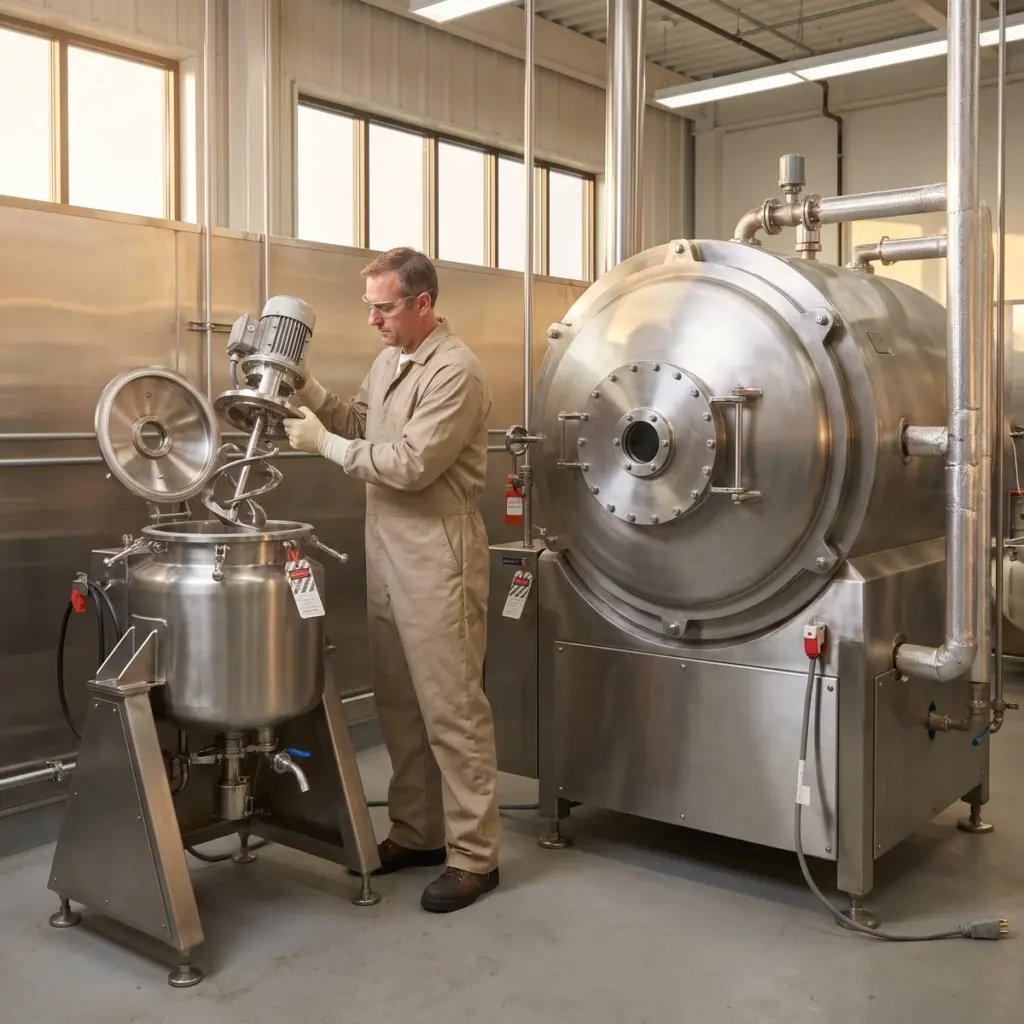
The team starts from the laboratory process: order of addition, phase temperatures, mixing speeds, homogenisation time and cooling profile. They compare the laboratory and pilot equipment with the production vessel, homogeniser, scraper agitator and vacuum capability, and translate each setting into an equivalent on the larger plant.
Trial batches and in-process testing
Engineering or pilot batches are made at an intermediate size and then at full scale. Samples are taken at set points and tested against the standard.
- Viscosity and rheology profile
- pH and appearance
- Droplet or particle size under the microscope
- Colour and odour against the standard
- Homogeneity across the top, middle and bottom of the vessel
Where a result drifts, settings are adjusted and the batch repeated until the product matches.
Transfer documents for production
You receive a master manufacturing instruction for the production plant, a list of critical process parameters with their ranges, the in-process control plan and the trial batch records. Samples from the first full-size batches go on stability to confirm they match the laboratory batches.
When and how to commission pilot-to-industrial scale-up
Scale-up sits between development and the first commercial order, and its timing affects your stability data and launch date.
Timing scale-up in the launch plan
Plan scale-up as soon as the formula is fixed and the production site chosen. Retailers and distributors often want samples from a production batch, and stability data on production-scale batches gives a stronger basis for the shelf life you print. Leaving the work until the first commercial order risks a batch that fails its specification.
Information to hand over
Give the receiving site the complete formula with raw material grades and suppliers, the laboratory process notes, batch records from the pilot runs, the finished product specification and the retained laboratory standard. Notes on what went wrong in development, for example a phase that separates if cooled too fast, save trial batches.
Choosing a scale-up partner
Ask whether the provider has a pilot plant with the same mixing principle as the production vessels, since a matching geometry makes transfer more predictable. Look for experience with your product type: hot-process emulsions, cold-process gels and pressed powders all present different challenges. Once the process is validated, routine batches continue under manufacturing from your formula.
More in Cosmetic Manufacturing
Cosmetic manufacturing, private label and production scale-up: routes for making your product, from a catalogue base to your own formula.