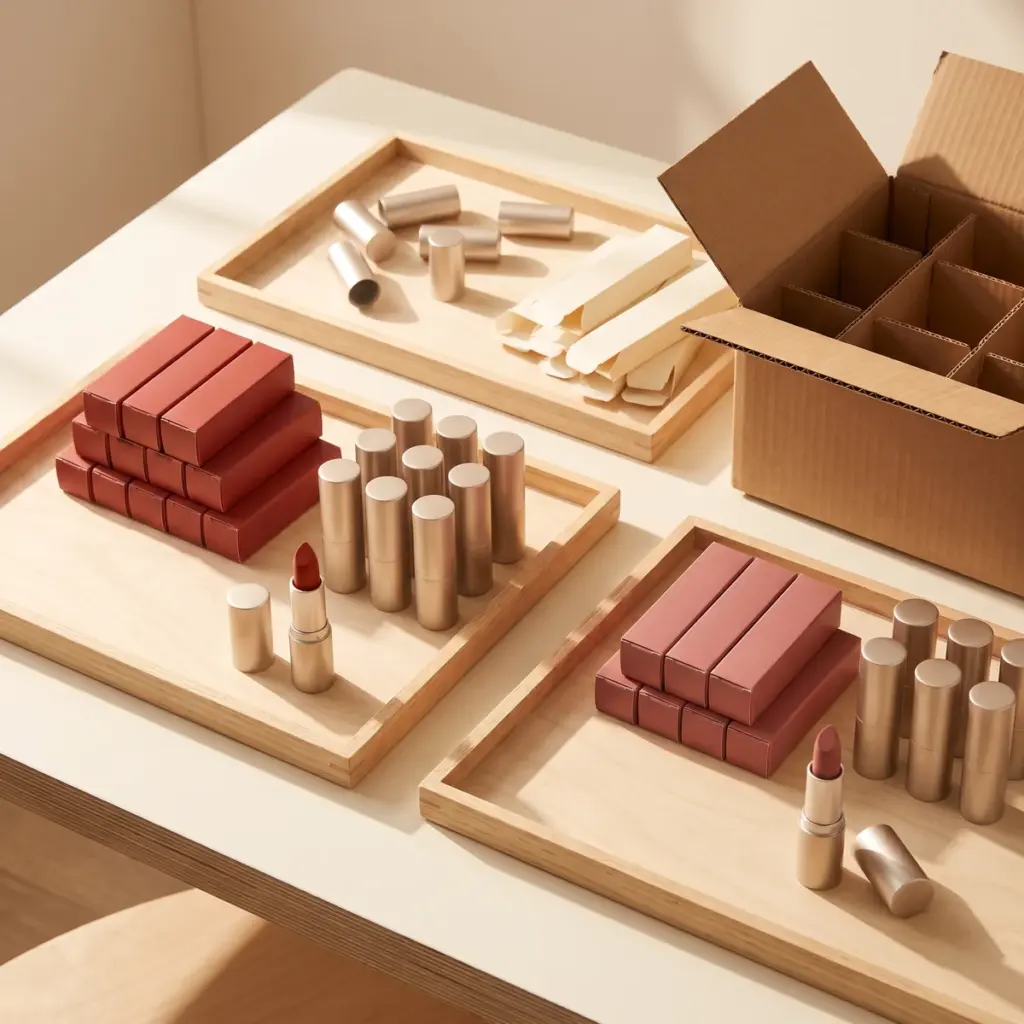
A minimum order quantity (MOQ) only becomes useful once you know what it counts. A quoted “MOQ 1,000” could mean kilograms of bulk, units of a component, filled units per run or finished units of one SKU, and a single offer can contain several minimums at once. Before treating a quote as an order plan, find out which quantity each minimum governs and check that they fit together.
This guide walks through the quantity layers, converts batch mass into units, splits a batch across SKUs, tracks leftover components and ends with a request you can send to suppliers. The worked numbers are invented to make the arithmetic visible; they are not supplier minimums or industry benchmarks. For where ordering sits in the wider project, see the cosmetic product development roadmap.
What does a cosmetic manufacturing MOQ cover?
Phrases like “low MOQ” leave open how much bulk, how many packs and how many finished units you are agreeing to buy. Each minimum needs a product, a unit and a scope before you can plan around it.
One supplier’s explanation shows how many layers can be involved. Shay Labs’ MOQ page (retrieved 23 October 2026) says formula development, packaging component, decoration, filling and direct manufacturing minimums can all be different, and that sample and development work has a different scope from commercial finished-unit runs.
Ask each supplier to tie every quoted minimum to a formula version, pack configuration, variant and included service. Ask, too, what counts as a separate SKU (stock-keeping unit) in their offer: does a different size, label or decoration start a new minimum? Record the answers in your formulation brief so the lab quotes the same product your team is planning.
How do formula, packaging and filling minimums differ?
Separate the layers first, then try to make the numbers line up. A given supplier may apply only some of these.
For each line, record the minimum, order increment, quoted quantity, owner and any open condition. Variants that share a container may still be treated separately for filling, so confirm pooling with the supplier. Carry the schedule into the development cost worksheet, keeping components, filling and finished-unit charges on separate lines so nothing is counted twice.
How do you estimate units from batch mass and fill size?
Divide the mass available for filling by the mass used per fill. The starting batch mass is usually larger than what reaches the filler, and each fill still has to pass checks before it becomes a saleable unit.
Worked example, with invented figures:
Starting bulk mass             100 kg
Mass available for filling      90 kg   (10 kg excluded, counted once)
Mass per fill                   50 g
Fills = 90,000 g / 50 g    =  1,800 units
Count the excluded mass once. Subtracting the 10 kg and then also applying a 90% yield factor would double-count the same loss.
The 1,800 figure counts fills. Real orders can also lose units to rejects, retained samples (units kept for later examination) and overfill (product filled above the stated quantity). This example leaves them out to keep the arithmetic simple; ask the supplier which apply to your order and how they define a deliverable unit.
The example works in mass throughout. If your pack is labelled by volume, such as 50 mL, get the product’s density and filling basis from the manufacturer to convert between the two.
Can one batch cover several SKUs?
Sometimes, if the supplier confirms it. Formula variants, pack sizes, labels and filling setups can each carry their own minimum, so check per SKU as well as for the project total.
Continuing the example: same formula, two label variants, 90 kg split as follows.
SKU A: 1,000 units x 50 g = 50 kg
SKU B:   800 units x 50 g = 40 kg
Total: 1,800 units, 90 kg
Now suppose the supplier requires 1,000 filled units per SKU (also invented). SKU A qualifies; SKU B falls 200 units short even though the total is 1,800. You could change the split, enlarge the batch or ask whether the terms can flex, and each option needs the supplier to confirm quantities, technical scope and price together. If the SKU plan changes, update the formulation brief before requesting a revised quote.
What happens when component purchases exceed the fill plan?
Component minimums can be larger than one fill run needs. The same Shay Labs page notes that unused components and materials still occupy space and tie up cash even when the finished-product MOQ looks manageable. Track leftovers separately from finished units.
Continuing the invented example, with one container, one pump and one label per unit and no breakage:
The 700 spare containers add no product, and SKU B is still 200 units short. Ask who owns the leftovers, where they will be stored, what storage costs and who checks they are still suitable before reuse. Budget for the full component purchase rather than only what the first run consumes.
What should the supplier MOQ request ask?
Send one request covering bulk, components, filling and deliverables together. Copy and adapt:
PROJECT / REQUEST VERSION / DATE:
FORMULA / PACK / SKU REFERENCES:
FIRST ORDER OR REORDER:

MINIMUMS
- Bulk minimum, unit and formula-specific conditions:
- Component minimums and order increments, per reference:
- Decoration/artwork minimums and what counts as a variant:
- Filling/packing minimum per SKU or format:
- Can quantities be pooled across SKUs? (confirm yes/no)

FROM BULK TO DELIVERED UNITS
- Fill basis: mass or volume, and density if volume:
- Your estimate of delivered units, and its assumptions:
- Yield definition and the stage it covers:
- Losses, overfill, breakage and retained samples, included or excluded:
- How overlapping allowances are kept from being counted twice:
- Definition of a delivered unit and permitted variation:

LEFTOVERS AND TERMS
- Who buys surplus components and materials:
- Ownership, storage, charges, return or disposal:
- Conditions for using leftovers in a later order:
- Quote date, validity, inclusions and payment terms:
- Differences between first-order and reorder terms:
- Changes that would require a new quote:

DECISION
- Open quantity or technical issue / owner / next action:
- Commitment on hold until it is resolved:
Ask for an answer on every line. If the supplier leaves yield blank, keep it as an open question in your plan until they fill it in. Compare quotes once quantities and included services match.
Do first-order terms apply to reorders?
Confirm reorder terms separately; the supplier may set them higher, lower or the same. Check them for the current formula, components, artwork and fill basis, and list what inventory is left and whether it is still usable. Stored components, earlier capacity and past prices only carry over if the supplier confirms it in writing.
What should be resolved before placing the order?
Check that the brief, the quantity schedule and the budget all describe the same version of the product. In the example above, you would hold the bulk, component and filling orders until SKU B’s shortfall is settled and the supplier confirms how many deliverable units 90 kg will produce. Product release comes after that.
Shay Labs is cited only for how one supplier describes its minimums and unused inventory. Its own unit minimums are not repeated here.