Hair care efficacy testing overview
Do you provide Hair care efficacy testing?
What hair care efficacy testing covers, fibre by follicle
Hair has a nonliving part and a living part, and each needs its own models. The shaft above the scalp is keratinised protein that can be damaged, coated or protected. The follicle below the surface is living tissue that produces new fibre, pigment and signalling molecules. A study plan starts by deciding which of the two your claim is about.
Fibre studies on the hair shaft
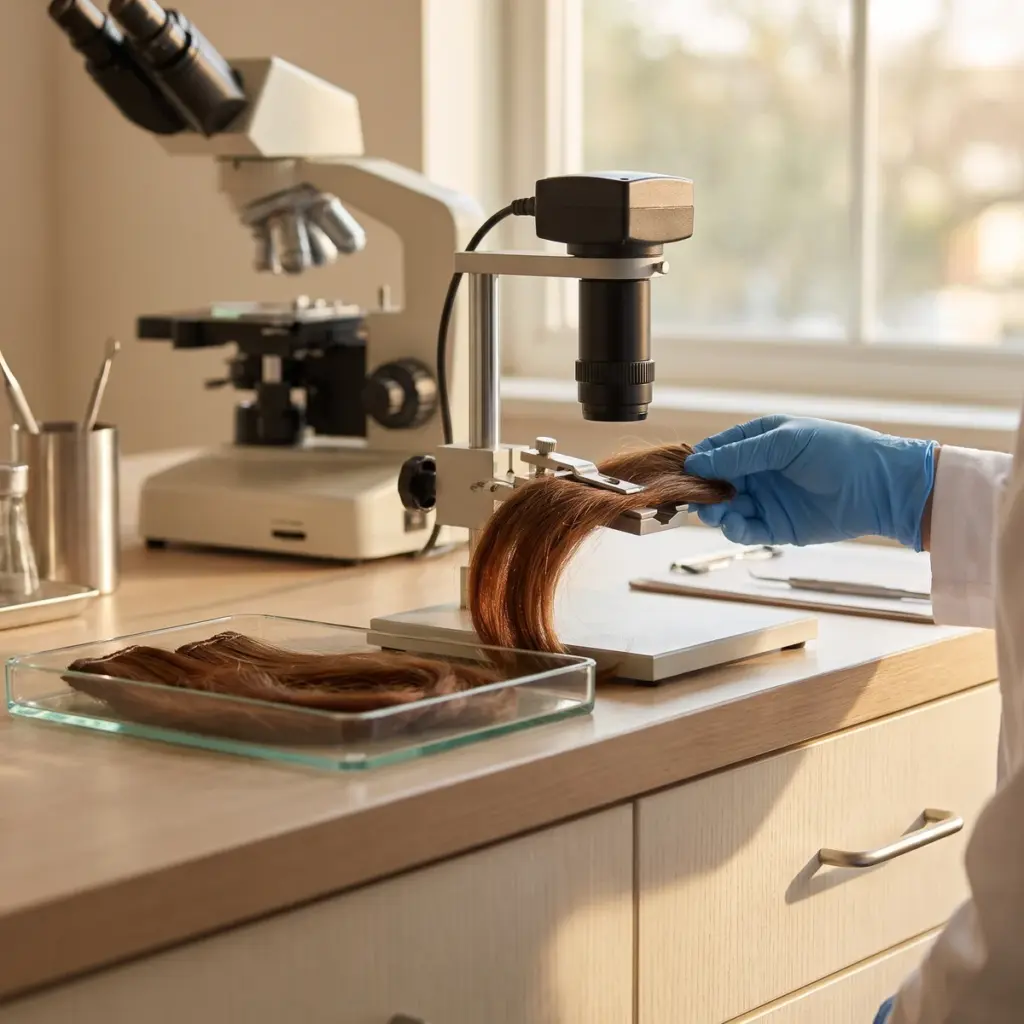
Matched tresses are treated with the product and then stressed by bleaching, heat styling or UV exposure. The laboratory measures protein released into wash solutions, amino acid changes, oxidation and mechanical behaviour. Matrix protein protection testing is the main study in this group.
Follicle growth and keratin production
Isolated human hair follicles kept in culture are monitored for shaft elongation and growth-phase status. Cell cultures add mechanism data: growth-factor release from dermal papilla cells, activation of follicular stem cells and keratin expression in follicular keratinocytes. Hair growth efficacy testing brings these endpoints together at follicle level.
Androgen pathways and pigment biology
Enzyme and cell assays measure the conversion of testosterone to dihydrotestosterone by 5α-reductase and the downstream androgen response in dermal papilla cells. Melanocyte and follicle models measure melanin content, tyrosinase activity and oxidative stress in the follicular pigment unit, which is the basis of greying research.
Hair study reports and data
Each study ends with a report giving the model, donor or tress details, treatment conditions, controls, raw and normalised data, statistics and photographs or micrographs where relevant. You can use it in an ingredient dossier, a technical data sheet or a claim support file.
Building a hair care efficacy testing programme
Most hair products need data from more than one model, and the order of studies decides how much you spend.
Matching fibre or follicle data to the hair claim
Write the claim you want to make before you ask for quotes. A shampoo that “helps protect hair from heat damage” needs fibre data. A scalp serum that “supports the hair growth cycle” needs follicle data. An active positioned for thinning hair usually combines an androgen-pathway assay with a follicle growth model. Matching the claim to the target saves money on studies that measure the wrong thing.
Sequencing studies for an active ingredient
Ingredient developers often screen several candidates in cell assays, such as DHT inhibition or growth-factor release, and then take the best one or two into isolated follicle culture. Positive follicle data is then the basis for a human study on the finished product, run by a clinical research organisation with phototrichogram or hair count methods.
Test material, hair type and donor questions
Provide the test material with its concentration range, solvent or vehicle, and any known solubility or colour issues that might interfere with optical readouts. For fibre work, state the hair type and level of prior damage you want to represent. For follicle work, ask about donor sourcing, how many donors the lab normally uses and how it records follicle viability, because donor variation drives much of the spread in the results.
More in Hair Follicle & Fibre
Hair Follicle & Fibre studies test how an active works on the living follicle and the hair shaft: growth signals, androgens, keratin and pigment.