Hair growth efficacy testing overview
Do you provide Hair growth efficacy testing?
Hair growth efficacy testing in cultured follicles
The isolated hair follicle model keeps a whole human follicle alive outside the body for several days. The follicle continues to produce hair shaft in culture, so the effect of an ingredient on growth can be measured directly on human tissue before any volunteer study.
Follicle preparation and culture
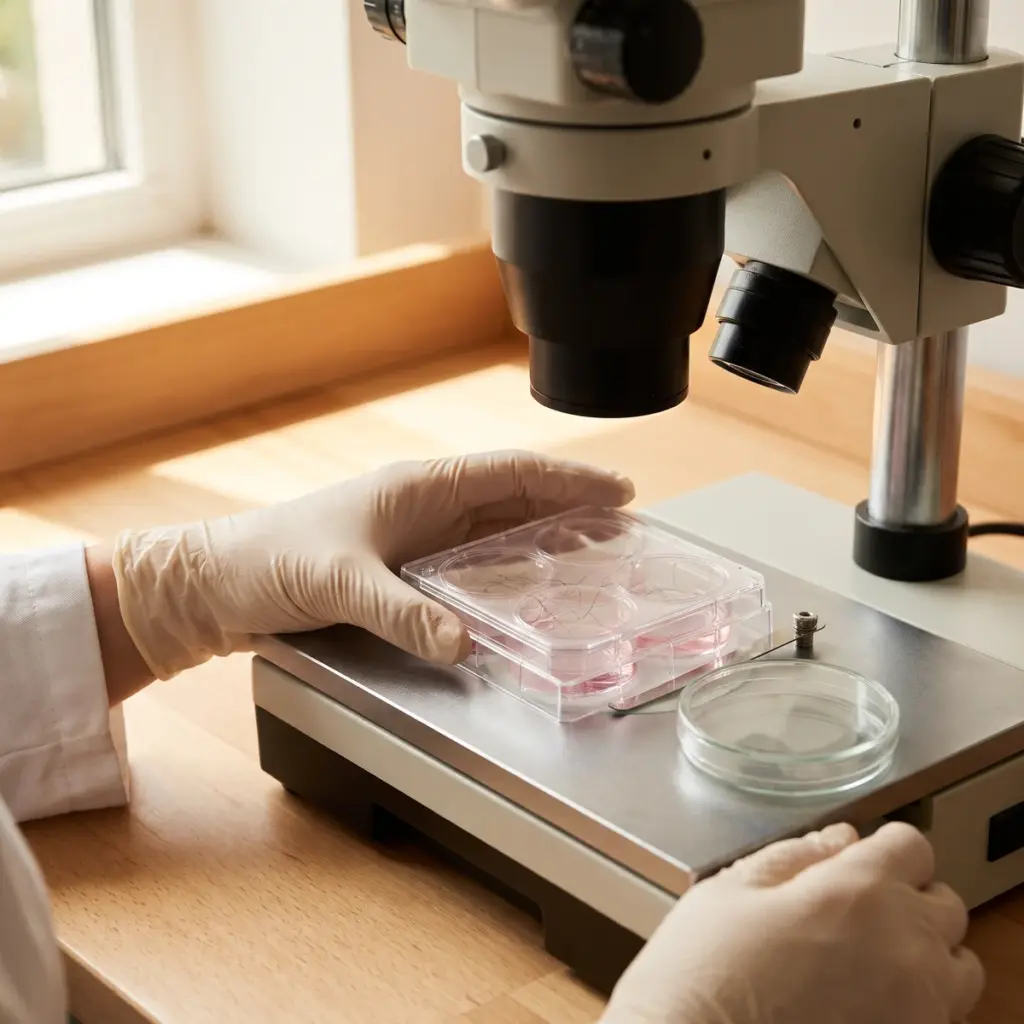
Follicles in the growth phase are microdissected from donor scalp tissue, usually obtained from cosmetic surgery with consent. They are placed individually in culture medium containing the test material, a vehicle control or a reference active. Follicles from each donor are distributed across groups so that donor variation is balanced.
Growth endpoints
- Hair shaft elongation measured on images taken over the culture period
- Growth-phase status scored from bulb morphology
- Proliferation and apoptosis markers in the bulb
- Follicle viability and tissue structure
Supporting cell assays
Dermal papilla cells and follicular keratinocytes are used to measure proliferation, growth-factor release or pathway markers. These assays explain how an active works, and the follicle culture shows the effect on the growing hair.
Delivery to the follicle
Where the formulation is the subject, permeation studies in Franz diffusion cells or follicular deposition methods show how much active reaches the skin and the follicle opening.
Elongation curves, growth-phase scoring and histology
You receive elongation curves per group, growth-phase scoring, histology or immunostaining images, statistics against vehicle, and donor details.
Planning hair growth studies from lab to volunteers
Hair growth claims are built in stages, and follicle culture is the stage where most actives are kept or dropped.
When to commission follicle culture
The follicle model is the step between mechanism screening and a clinical study. Ingredient teams typically arrive with data from growth-factor stimulation or DHT assays and use follicle culture to confirm that the active affects growth in intact human tissue. A clear elongation result also strengthens a supplier dossier, since it is measured on the hair shaft itself.
Moving to a claim on the finished product
A claim such as “visibly denser hair after three months” comes from a volunteer study on the finished product, run by a clinical research organisation with phototrichogram, hair counts or standardised global photography. Use the follicle results to set the active concentration and to justify the cost of that study.
Choosing a follicle laboratory
Ask where the donor tissue comes from and how many donors a standard study uses. Ask how the lab scores growth phase and whether that scoring is done blind to treatment. Laboratories that also offer histology and immunostaining on the same follicles can give you mechanism and growth data from one study.
More in Hair Follicle & Fibre
Hair Follicle & Fibre studies test how an active works on the living follicle and the hair shaft: growth signals, androgens, keratin and pigment.