Stem cell activation overview
Do you provide Stem cell activation?
How stem cell activation is measured in hair follicle models
Hair follicles regenerate in cycles. At the start of each new growth phase, epithelial stem cells in the bulge region are recruited to divide and supply the cells that build the new fibre. Testing for activation therefore needs two things: proof that the cells in the dish are this population, and functional readouts that show a change in their behaviour.
Establishing cell identity
The laboratory characterises its cultures or follicle tissue with stem and progenitor markers before treatment, and records the cell source, passage and culture conditions. Primary cells can drift in culture, so this baseline is part of the report. Dermal papilla cells are kept as a separate model because they are signalling cells that regulate the stem cells.
Functional endpoints
- Cell-cycle entry and proliferation of the identified population
- Colony-forming capacity in clonal assays
- Stemness and early differentiation marker patterns
- Viability across the concentration range
Pathway context
Activation of follicle stem cells is linked to Wnt signalling and other growth-regulatory pathways. Gene expression or reporter assays on these pathways give the activation data a mechanism that can be described in a technical dossier.
Stem cell identity and concentration-response data delivered
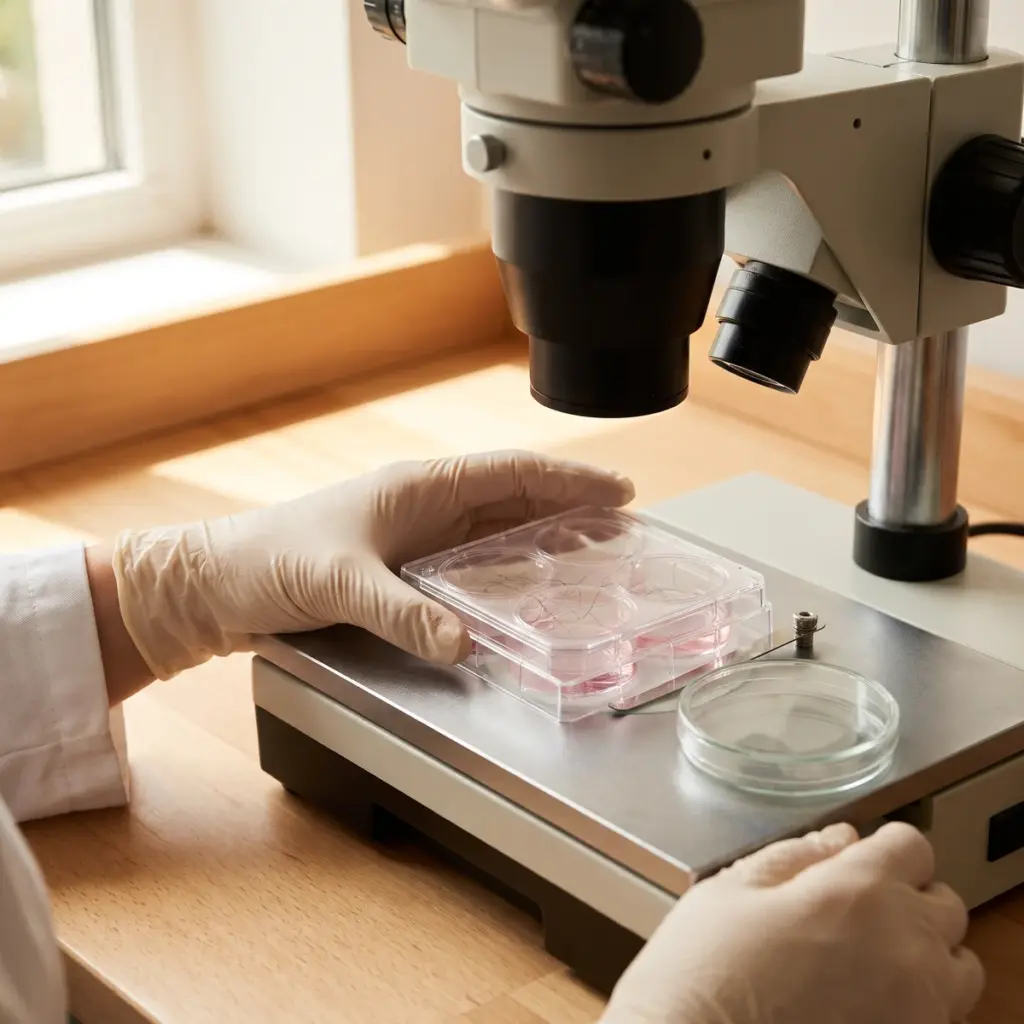
The report presents the identity characterisation, concentration-response curves for each endpoint against untreated and vehicle controls, statistical analysis, and representative images of stained cells or colonies.
Using stem cell activation data for a hair active
Stem cell activation results are mainly used in ingredient marketing and in the technical file of a new active. They support a mechanism statement such as “activates hair follicle stem cells in vitro” on a supplier data sheet, and give formulators a reason to choose one active over another.
Where it sits in a hair study plan
The study answers a cellular question. The usual next step is an isolated follicle culture, where hair growth efficacy testing measures shaft elongation and growth-phase status in whole tissue. Some programmes also run growth-factor stimulation on dermal papilla cells to show the signalling side of the same mechanism.
Questions to ask a provider
Ask which markers the laboratory uses to confirm stem cell identity and how it sources its cells, whether from human follicle donors or a characterised line. Ask whether it can measure proliferation directly, with DNA synthesis labelling or cell counts, because a metabolic dye reports overall activity of the culture and is a weaker readout for this question. A lab with colony-forming assays in routine use will give you the most convincing functional data.
More in Hair Follicle & Fibre
Hair Follicle & Fibre studies test how an active works on the living follicle and the hair shaft: growth signals, androgens, keratin and pigment.