Molecular Target Identification overview
Do you provide Molecular Target Identification?
How molecular target identification pins down an ingredient’s mode of action
A screening result tells you that an ingredient changes collagen, pigment or another endpoint. Target identification asks which molecule it acts on first. The study narrows the field from thousands of proteins to a short list of candidates, then tests whether those candidates account for the response.
Discovery methods for candidate targets
Laboratories choose and combine methods according to the chemistry of the compound and the response under study.
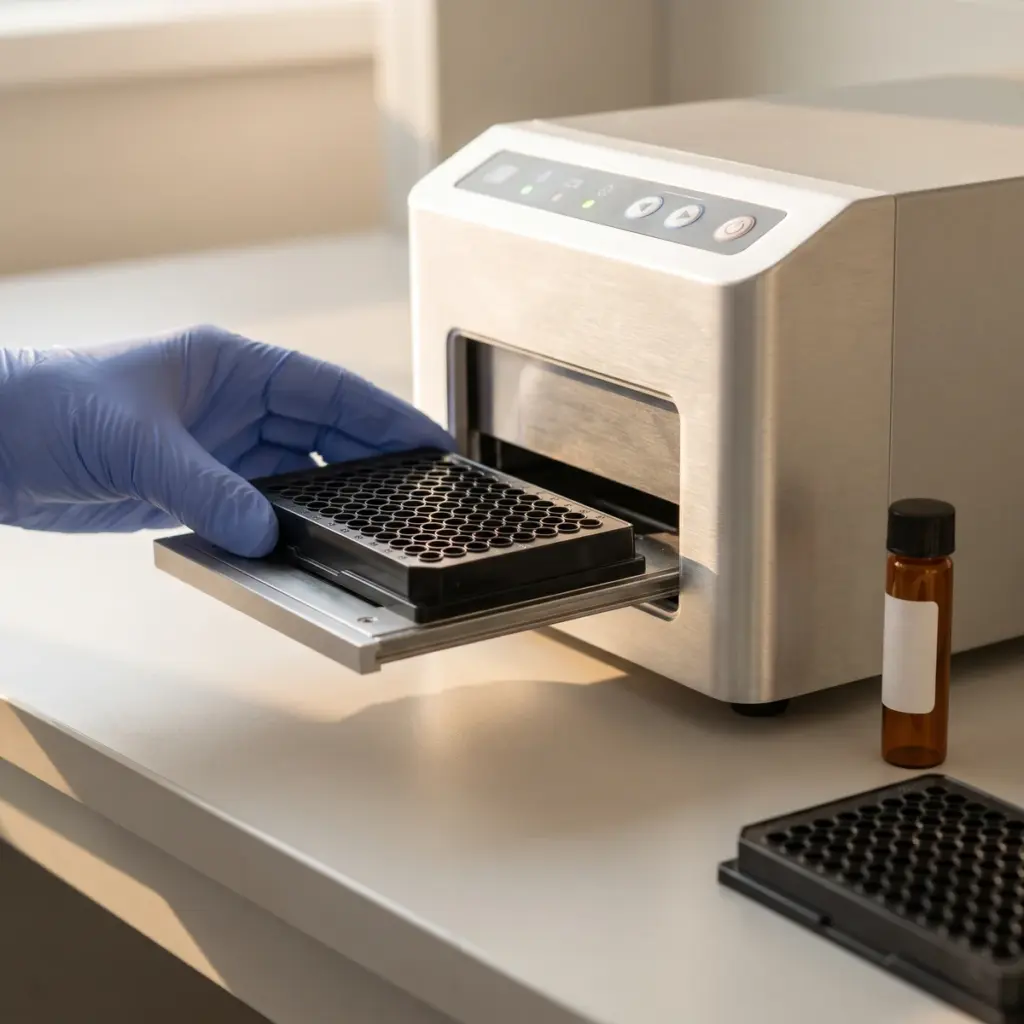
- Affinity pull-down and protein-binding experiments analysed by mass spectrometry proteomics
- Transcriptomics to map gene expression changes downstream of the target
- Enzyme activity assays on selected biochemical functions such as tyrosinase or collagenase
- Cell-based reporter assays that read out activity in a defined pathway
Binding and enzyme data point to direct interactions. Expression and reporter data show where the effect travels inside the cell. Reading the two together lets the laboratory tell a primary target apart from a secondary response.
Confirming the target and its downstream effects
Shortlisted targets are tested in follow-up experiments. These can include concentration-response curves, time-course sampling and knock-down or inhibitor studies in which the target is blocked to see whether the ingredient’s effect disappears. The laboratory then examines signalling downstream of the confirmed target and any cross-talk with neighbouring pathways.
Candidate targets, biomarkers and raw data reported
You receive a report that lists the candidate targets, the evidence behind each one and its strength, and the experiments used to confirm them. It identifies biomarkers suited to later efficacy work and the concentration range in which the ingredient engages its target. Raw data files and method descriptions are usually supplied for your technical dossier.
Putting molecular target identification to work in ingredient development
Target data are most useful between screening and the first human study.
From screening hit to explained active
The usual trigger is a candidate that performs well in a skin-cell screen, for example raising procollagen or lowering melanin output, with no clear explanation. Knowing the target lets your team compare the ingredient with known actives on the same target and argue its novelty in sales and technical documents.
Once a target is in hand, receptor binding studies can quantify affinity and selectivity if the target is a receptor, and biological pathway investigation can map the signalling route from target to visible endpoint.
Preparing a target identification request
Send the provider a well-characterised sample with its composition, purity and solubility, plus the screening data that prompted the question. Say which response you want explained and in which cell type it was seen. For complex botanical extracts, ask how the laboratory handles mixtures, since affinity pull-down works best when a main active fraction can be isolated or tagged. Laboratories with in-house mass spectrometry proteomics and experience of gene knock-down in keratinocytes, fibroblasts or melanocytes can take a project from discovery to confirmation without outsourcing steps.
More in Mechanism Investigation
Mechanism investigation identifies the molecular targets, receptors and pathways a cosmetic active works through, using cell and molecular methods.