Eye Irritation Testing overview
Do you provide Eye Irritation Testing?
Eye irritation testing methods and what each one decides
Laboratories assess ocular hazard with methods that each answer one part of the question. Some identify materials that need no classification. Others identify materials that cause serious eye damage. A testing strategy combines them, starting from what is already known about the material.
Reconstructed human cornea-like epithelium
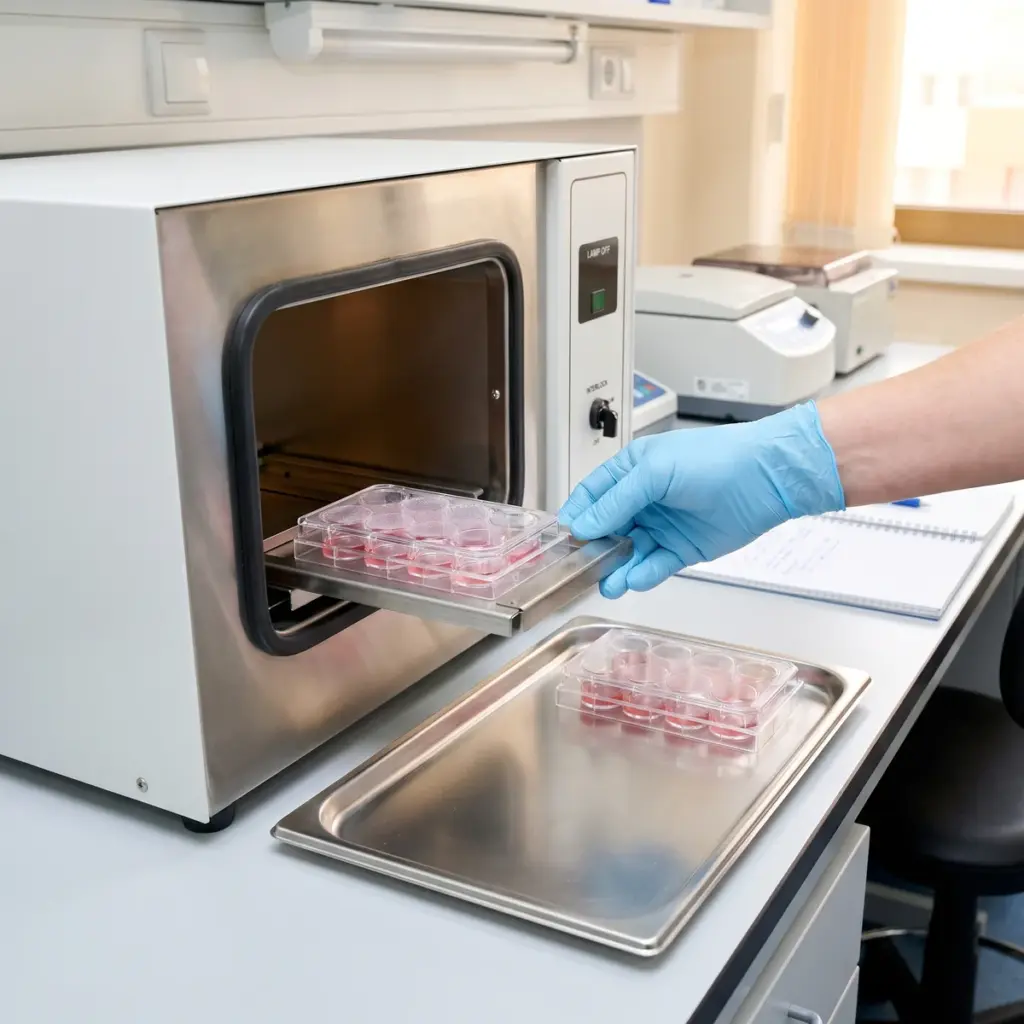
Under OECD Test Guideline 492, the test material is applied to a three-dimensional tissue grown from human corneal or epidermal keratinocytes in a corneal configuration. After exposure, rinsing and a post-exposure incubation, viability is measured by MTT conversion. A viability above the method’s cut-off identifies the material as not requiring classification for eye irritation or serious eye damage.
Bovine corneal opacity and permeability (BCOP)
The BCOP test, OECD Test Guideline 437, uses corneas from cattle supplied by abattoirs as a by-product of the food chain. The material is applied to the corneal surface in a holder. An opacitometer then measures loss of transparency, and the passage of fluorescein dye through the cornea measures damage to the barrier. The two values combine into an in vitro irritancy score that identifies serious eye damage and materials needing no classification.
Supporting screening methods
The hen’s egg test on the chorioallantoic membrane (HET-CAM) scores bleeding, lysis and coagulation of the membrane blood vessels after application. It is used in formulation screening to compare products.
Replicate values and prediction model outcome
Each study report gives the test item description, the method and guideline, controls and acceptance results, the measured values per replicate and the prediction under the method’s model.
Planning eye irritation testing for an ingredient or product
A well-ordered eye irritation programme often reaches a classification with a single study.
Bottom-up or top-down
The order of tests follows what you expect the result to be. For a mild material, such as a conditioning ester or a humectant, start with the reconstructed tissue method: a viability above the cut-off settles the question in one study. For a material likely to be strongly irritating, such as a concentrated surfactant or an acid, start with BCOP to confirm serious eye damage directly. Your laboratory can recommend the sequence once it has the material’s chemistry and any existing data.
Products used around the eye
Hazard data on ingredients go into the toxicological safety assessment, together with concentrations and exposure for the finished product. For mascaras, eyeliners and eye creams, the assessment then supports volunteer studies through ophthalmologist-supervised tolerance testing, which provides the data behind claims such as ophthalmologically tested.
Sample considerations
Tell the laboratory whether the material is a liquid, a viscous paste or a solid, since application volumes and rinsing steps differ by form. Coloured materials and materials that reduce MTT need extra control tissues in the reconstructed tissue method. Volatile solvents may need a specific application protocol.
More in In Vitro & In Chemico Safety Testing
In vitro and in chemico safety testing uses cell cultures, tissue models and chemical assays to identify irritation, sensitisation and phototoxic hazards.