Active ingredient quantification overview
Do you provide Active ingredient quantification?
Measuring active content: techniques and method validation
Every assay begins with a defined analyte and a target concentration. The laboratory then chooses a technique able to pick that compound out of a matrix of oils, emulsifiers, polymers and fragrance, and to tell it apart from its own degradation products.
Choosing the analytical technique
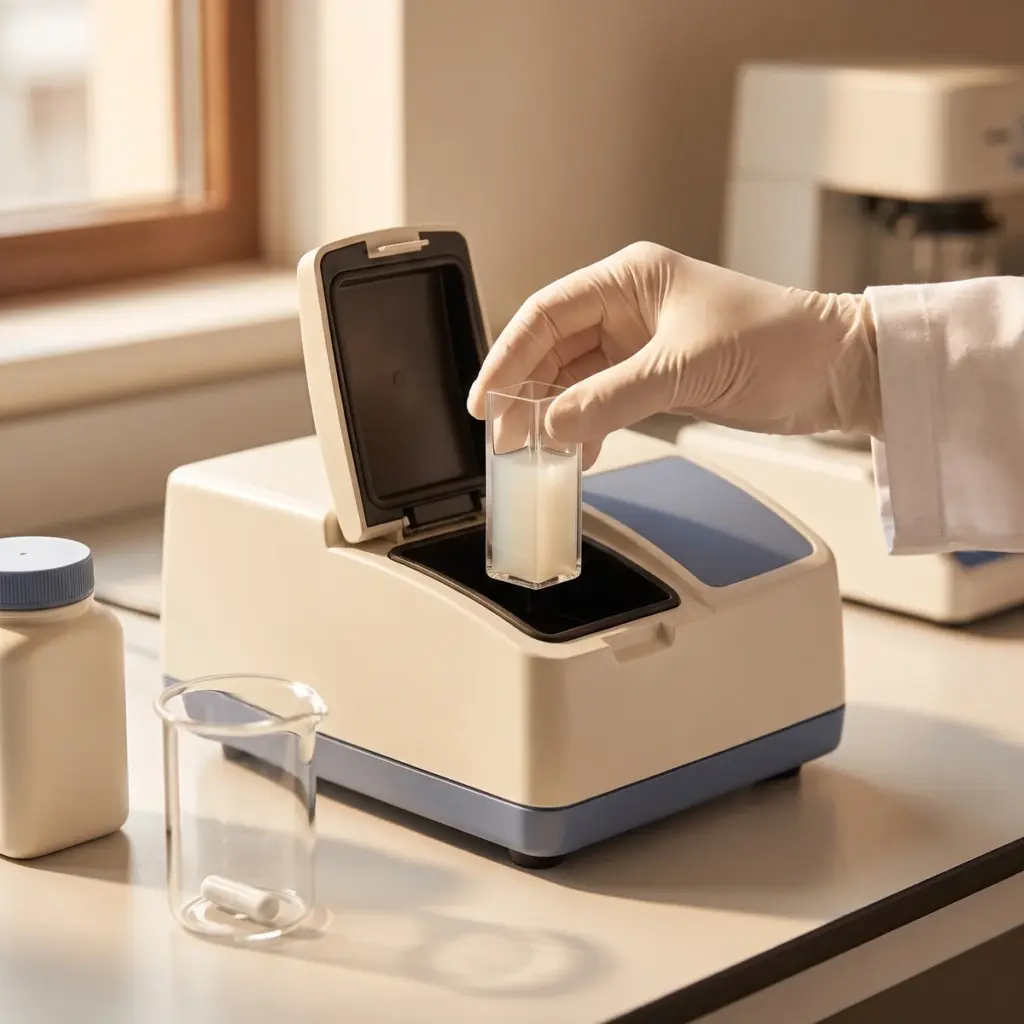
HPLC with UV or diode-array detection covers most vitamins, niacinamide, preservatives and other non-volatile actives. Gas chromatography suits volatile analytes. UV-visible spectroscopy is a quicker option for a compound with a clear absorbance and little interference from the base. LC-MS adds sensitivity and identity confirmation for low-level analytes, and peptides, proteins or botanical markers often need a method developed for that material.
Validating the method for your formula
A method that works on a raw material may need adjusting for a finished cream. Validation in the product matrix typically covers:
- Calibration with reference standards across the working range
- Recovery of the analyte from the finished-product base
- Selectivity against excipients and degradation products
- Repeatability and intermediate precision
- Limits of detection and quantification
Results and documentation
The report or certificate of analysis names the analyte, the method, the units and the measurement uncertainty, alongside the declared or target value for comparison. For stability work the laboratory uses a stability-indicating method, so you see the active level and the main degradation products at each time point.
Using active ingredient data from scale-up to shelf life
Assay results feed three decisions: whether a batch matches its label, how long the product keeps its declared level and how much overage to add.
Checking concentration through manufacture
A label statement such as 2% niacinamide needs an assay of the finished product, and scale-up is the stage where content most often drifts. Sampling at the top, middle and bottom of a vessel, or at the start and end of a filling run, shows whether the active is evenly distributed and whether heat or mixing time has reduced it.
Supporting stability and shelf-life decisions
Vitamin C derivatives, retinoids and some peptides lose content in storage, and the pack affects how quickly. Assaying the active at each stability time point, in each pack under test, gives the decline curve that formulators and safety assessors use to set the shelf life and any overage added at manufacture. Pair it with cosmetic physicochemical testing to see whether pH or viscosity shift alongside the loss.
Analyte, CAS number and base sample to send
Give the laboratory the analyte name and CAS number if known, the expected concentration, the product format and, where possible, the INCI list. A sample of the base without the active is useful for recovery and selectivity work. Say whether you need a validated method for repeat release testing or a single measurement, because the first takes longer to set up.
More in Physicochemical Testing
Physicochemical testing measures a cosmetic’s active content, pH, viscosity, particle size and structure to set specifications and explain changes.