UV-Response Mechanism Studies overview
Do you provide UV-Response Mechanism Studies?
How UV-response mechanism studies work across optical and biological endpoints
UV-Response Mechanism Studies split into two groups. Optical studies measure what happens to the light. Biological studies measure what happens in skin cells after UV reaches them. All share a controlled irradiation step, with a defined spectrum and dose from a solar simulator or UV lamp.
Optical absorption and reflection
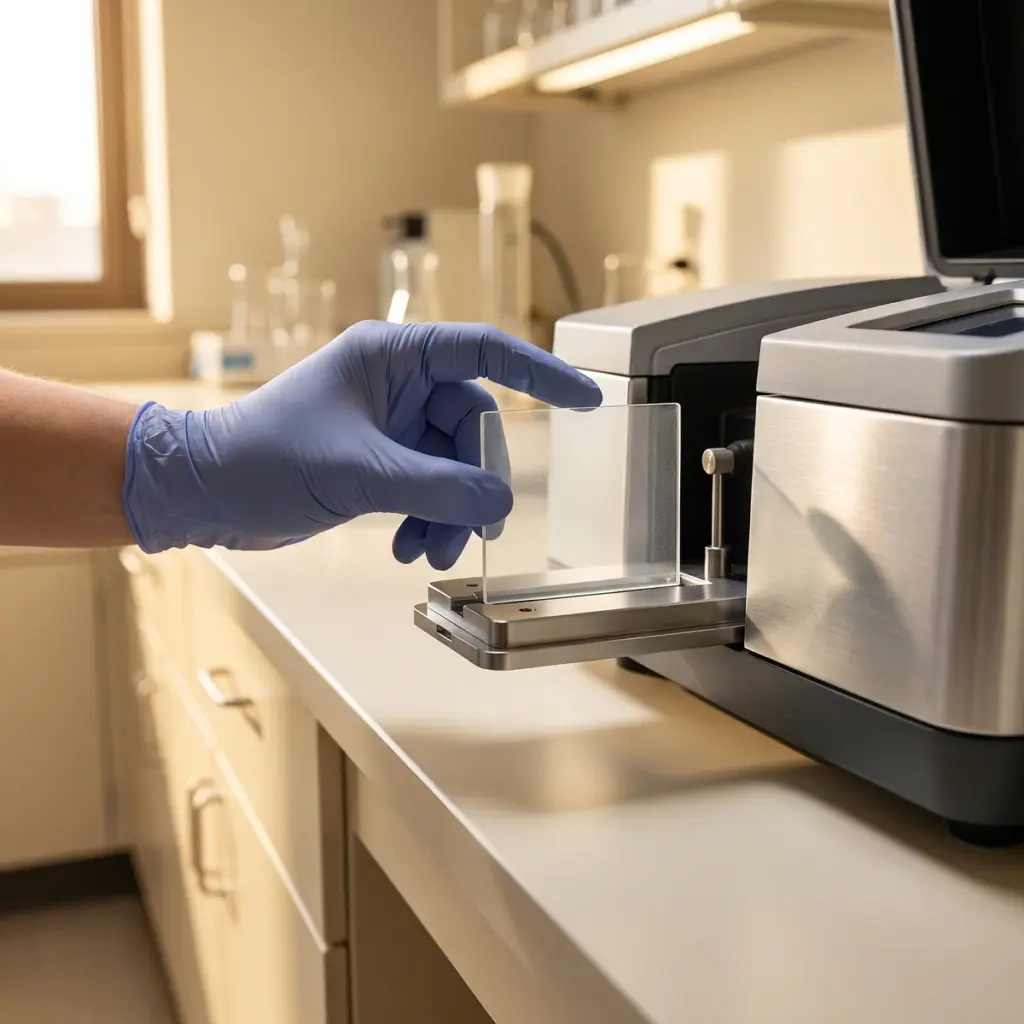
UV absorption and reflection testing spreads the material as a film on a roughened plate and records transmission across UVB and UVA with a spectrophotometer. The spectrum shows where an ingredient absorbs and how broad its coverage is.
Free radicals and DNA
UV generates reactive oxygen species in skin cells. ROS scavenging assays measure how far an active lowers these after irradiation. DNA protection testing quantifies lesions such as cyclobutane pyrimidine dimers and oxidised bases, and DNA repair stimulation follows how fast those lesions are removed over a time course.
Cell stress and immune response
Heat shock proteins induction studies measure stress proteins that help cells cope with UV and heat. UV-Exposed Skin Immune-Function Studies examine Langerhans cells, cytokines and other immune markers after exposure in cell or tissue models.
Irradiation records and results
Each study reports the irradiation spectrum and dose, model, controls and time points, with quantitative data, statistics and images where staining is used. UV source calibration records are usually attached as an appendix.
Services in UV-Response Mechanism Studies
Choosing among UV-response mechanism studies
The seven studies in this group answer different questions, so the choice starts with the benefit you want to describe.
Pick the endpoint that matches the claim
An antioxidant serum promising defence against UV-induced free radicals needs ROS data. A day cream with a DNA-protecting active needs lesion counts with and without the product. An after-sun product with a repair positioning needs a time course from DNA repair stimulation testing. Ingredient suppliers often combine two or three endpoints into one mechanism package.
Relationship with SPF and UVA testing
Mechanism studies describe what an ingredient does inside the skin or how it handles light. Protection values printed on a sunscreen label come from standardised methods covered under Sun Protection / SPF Testing. A sun care launch typically uses both: the SPF and UVA study for the label, and mechanism data for additional benefit claims.
Points to agree before testing
Confirm the UV source, its spectrum and the dose the model receives, and how the product is applied, whether added to the medium or applied topically to reconstructed skin. Coloured or opaque formulas can shield cells or interfere with optical readouts, so the laboratory may run interference controls. Ask which time points are sampled, since DNA repair and immune markers change over hours to days.
More in Photoprotection Testing
Photoprotection, SPF and UV response testing rates sunscreen SPF, UVA protection and water resistance, and maps how skin cells respond to UV.