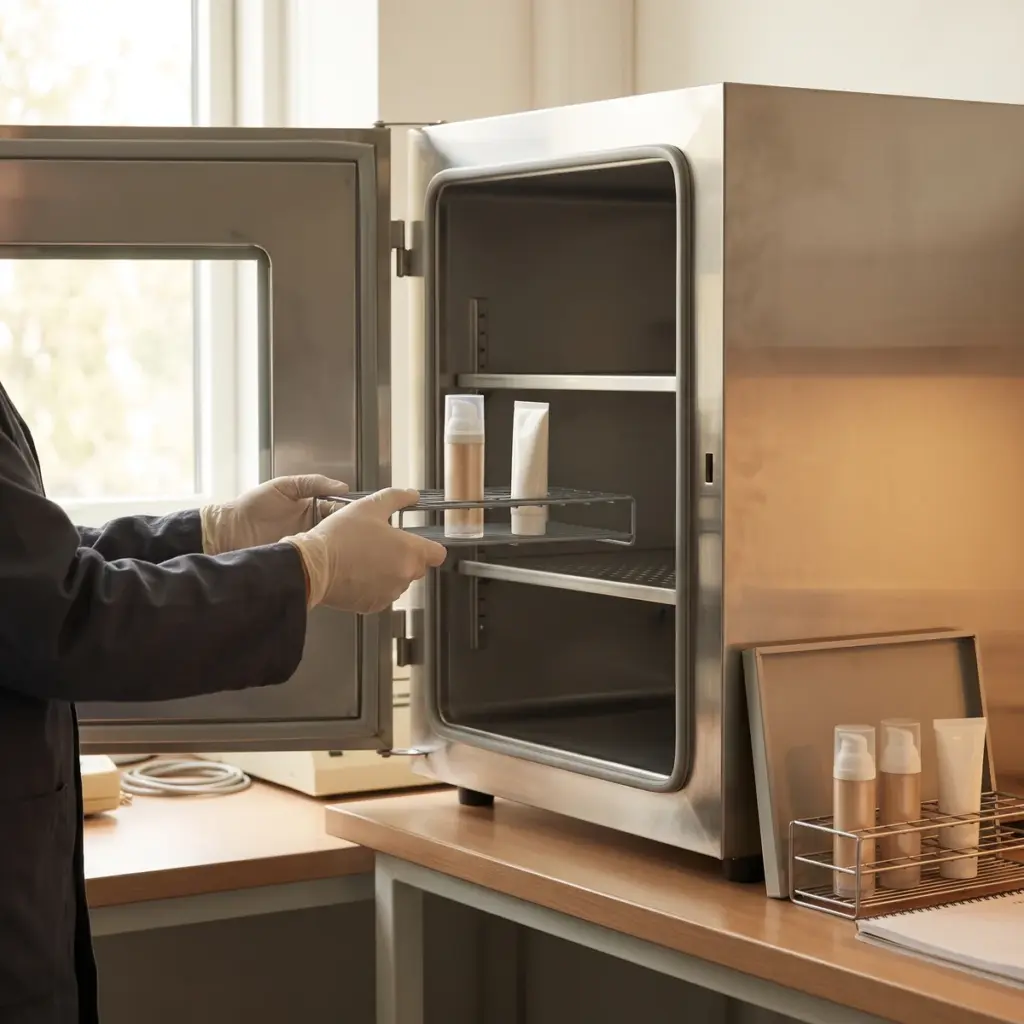
Accelerated Stability Testing overview
Do you provide Accelerated Stability Testing?
How accelerated stability testing is set up and measured
The study starts with a protocol agreed between you and the laboratory. It fixes the storage temperatures, any humidity control, the pack the product is filled into, the pull points and the acceptance criteria for each parameter. Samples come from a representative batch, filled into the final container or a close equivalent, with extra units set aside so every time point is tested on unopened product.
Storage conditions and reference samples
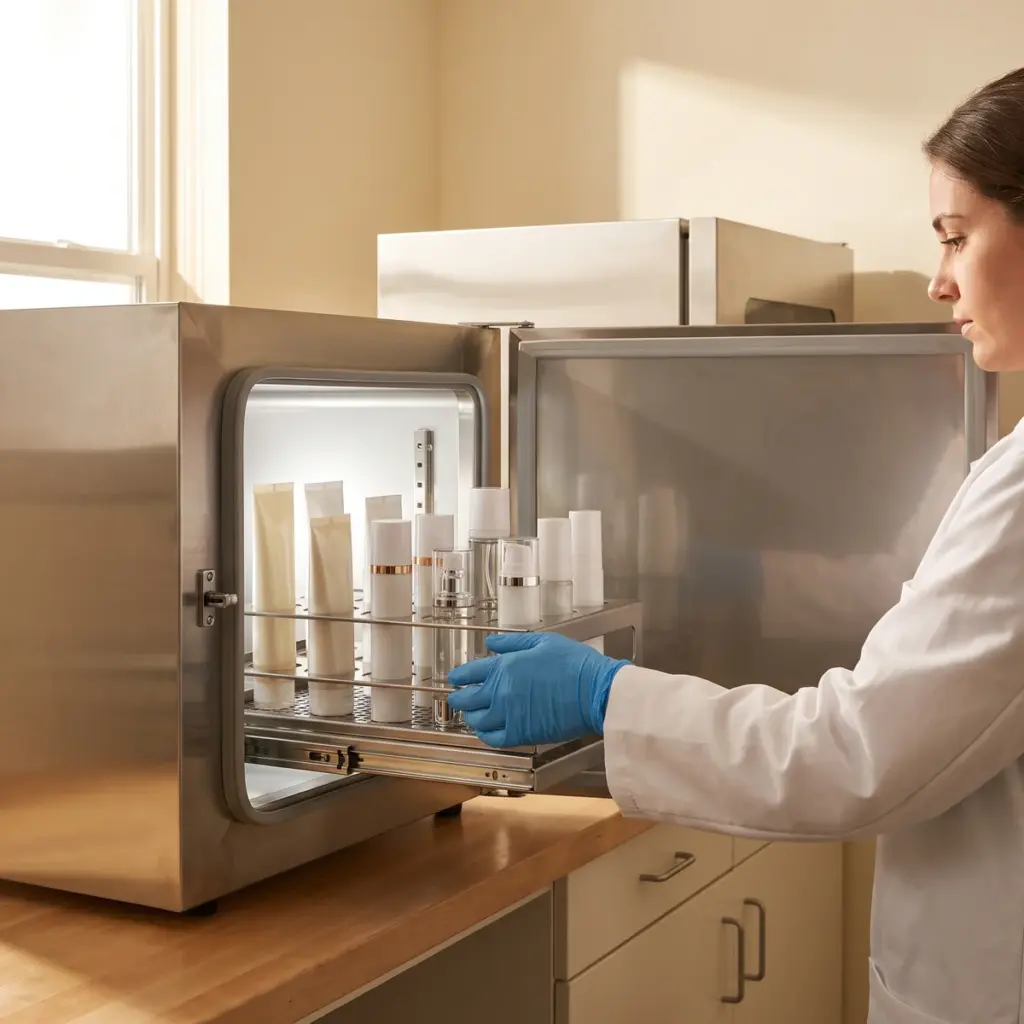
Typical designs run one or more elevated temperatures next to a room-temperature condition and a cold reference. The cold sample gives the analyst an unchanged comparator for colour and odour. Where the formula holds water-sensitive or volatile ingredients, humidity-controlled chambers and weight checks are added. Light is kept out so that heat is the only stress. Light exposure is the subject of product photostability testing, and repeated warm and cold transitions are covered by temperature cycling and freeze-thaw studies.
Parameters checked at each pull point
- Appearance, colour and odour against the reference
- pH and viscosity
- Phase separation, sedimentation or crystal growth, checked by microscopy or centrifugation
- Content of selected actives, preservatives or degradation markers
- Weight loss and the condition of the container and closure
- Microbiological quality where the protocol includes it
Results per storage condition and time point
You receive a report with the protocol, the batch and pack details, a results table for every condition and time point, and photographs of the samples. Each parameter is marked against its acceptance limit. Any trend, such as a steady pH drift or a fall in an active, is flagged with the time point where it began. The report closes with the laboratory’s reading of the data for the formula and pack tested, which your team can carry into the stability section of the product file.
Putting accelerated stability testing to work in development
Heat-stressed storage gives formulators answers in weeks, at the stage where changing an emulsifier or a pack still costs little.
Screening formulas and packs before scale-up
The most common use is comparison. Running several prototype formulas, or one formula in two candidate packs, under the same heat stress shows which version holds its viscosity, colour and active content and which drifts. You can then drop weak candidates before pilot batches and consumer testing. The same design checks the effect of a new emulsifier supplier, a fragrance change or a lower preservative level on an existing product.
Supporting a provisional shelf life
Accelerated data give your safety assessor and regulatory team an early stability rationale for launch, written up with the conditions and pack actually tested. Real-time samples stored at room temperature continue in parallel, and later pull points confirm or adjust the shelf life printed on pack. If heat stress shows the formula reacting with its container, a product-packaging interaction study is the next step to identify what is moving between the two.
Pull points, specifications and units to state
Laboratories price these studies on the number of conditions, pull points and tests per point. Have the following ready:
- Product type, intended markets and target shelf life
- Number of formulas and pack variants
- Specification limits for pH, viscosity and any assayed ingredients
- Whether microbiological checks and real-time storage are included
- Quantity of filled units you can supply
More in Stability & Packaging Compatibility
Stability & packaging compatibility testing stores a cosmetic in its final pack under heat, cold and light to set shelf life and confirm pack fit.