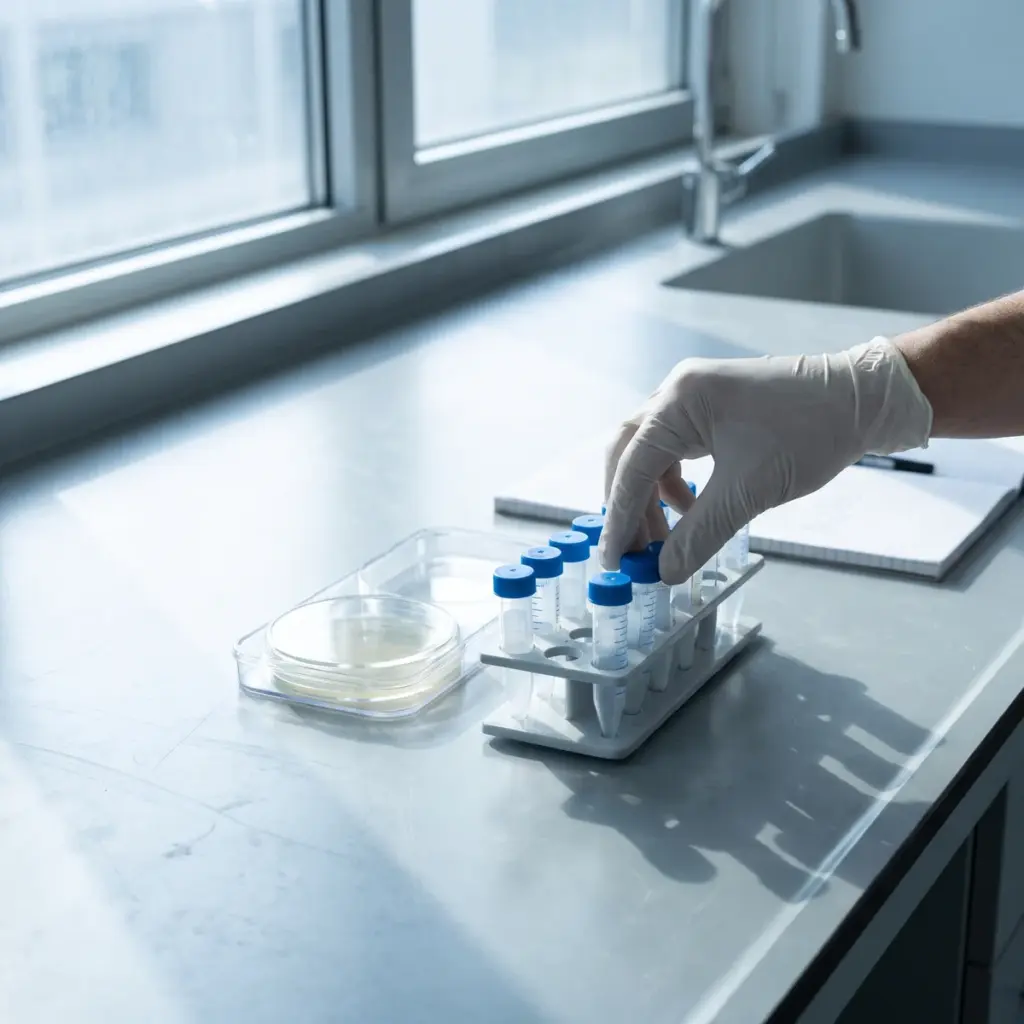
Skin microbiota efficacy testing overview
Do you provide Skin microbiota efficacy testing?
How skin microbiota efficacy testing is designed
A microbiota study starts from the organisms that matter for the product. Typical panels include skin commensals such as Staphylococcus epidermidis and Cutibacterium acnes, with Staphylococcus aureus or Malassezia species added when the brief concerns blemish-prone or flaking skin. The laboratory then picks a test system that fits the question.
Single strains, co-cultures and colonised skin models
Single-strain cultures give a clear growth or inhibition reading for each organism across several concentrations. Co-cultures of two or more species show whether the material shifts the ratio between them, for example favouring a commensal over S. aureus. Reconstructed epidermis colonised with bacteria brings in the host, so the model shows how skin cells and bacteria respond together. Host defence peptides measured in these models are covered in more depth under antimicrobial peptides production.
Culture counts, growth curves and sequencing
Viable counts on agar give the number of living, recoverable organisms after exposure. Optical density readings track growth curves over time. 16S rRNA gene sequencing, or quantitative PCR for chosen species, describes the make-up of a mixed community and how it moves after treatment. Acidity has a strong effect on skin bacteria, so many protocols log the pH of the test system, and some add a dedicated microbial pH-response study.
Strain growth data, community charts and host-response results
- Organisms, media and exposure conditions used
- Growth or inhibition data per strain and concentration
- Community composition charts where sequencing was run
- Host-response results from colonised skin models
- Statistical comparison with untreated and vehicle controls
Using skin microbiota efficacy testing in product development
Most brands commission microbiota work at two points: while choosing actives for a new microbiome range, and when the final claim wording is being fixed.
Claims the data can support
Strain and community results support mechanism claims about the skin flora, such as a formula that maintains the growth of skin commensals, or an ingredient that limits S. aureus while S. epidermidis stays at control levels. Ingredient suppliers put the same data in technical dossiers so formulators can compare actives on equal terms. If your claim concerns how gently a finished product treats the skin flora, a microbiome friendly formulation test on the final formula is the next step.
Target organisms, vehicle and preservative details to send
Before asking for a quote, decide which organisms your claim names and at what concentration the ingredient will sit in the finished product. Send the material with its solvent or vehicle. If you are testing a full formula, include details of the preservative system, because preservatives act on every strain in the panel. A short panel built around the claim gives a clearer answer than a long list of unrelated strains.
Culture collection strains and anaerobic growth to check
Look for a laboratory that holds the strains you need from a recognised culture collection and can grow anaerobes, since C. acnes is cultured under anaerobic conditions. Ask whether sequencing and bioinformatics are done in-house, and whether the team has run colonised reconstructed skin models before if host response is part of your question.
More in Microbiome Interaction Studies
Microbiome Interaction Studies show how a cosmetic ingredient or formula affects skin bacteria, from lone strains in culture to communities on volunteers.