Instrumental color measurement overview
Do you provide Instrumental color measurement?
Colour measurement methods for cosmetic shades
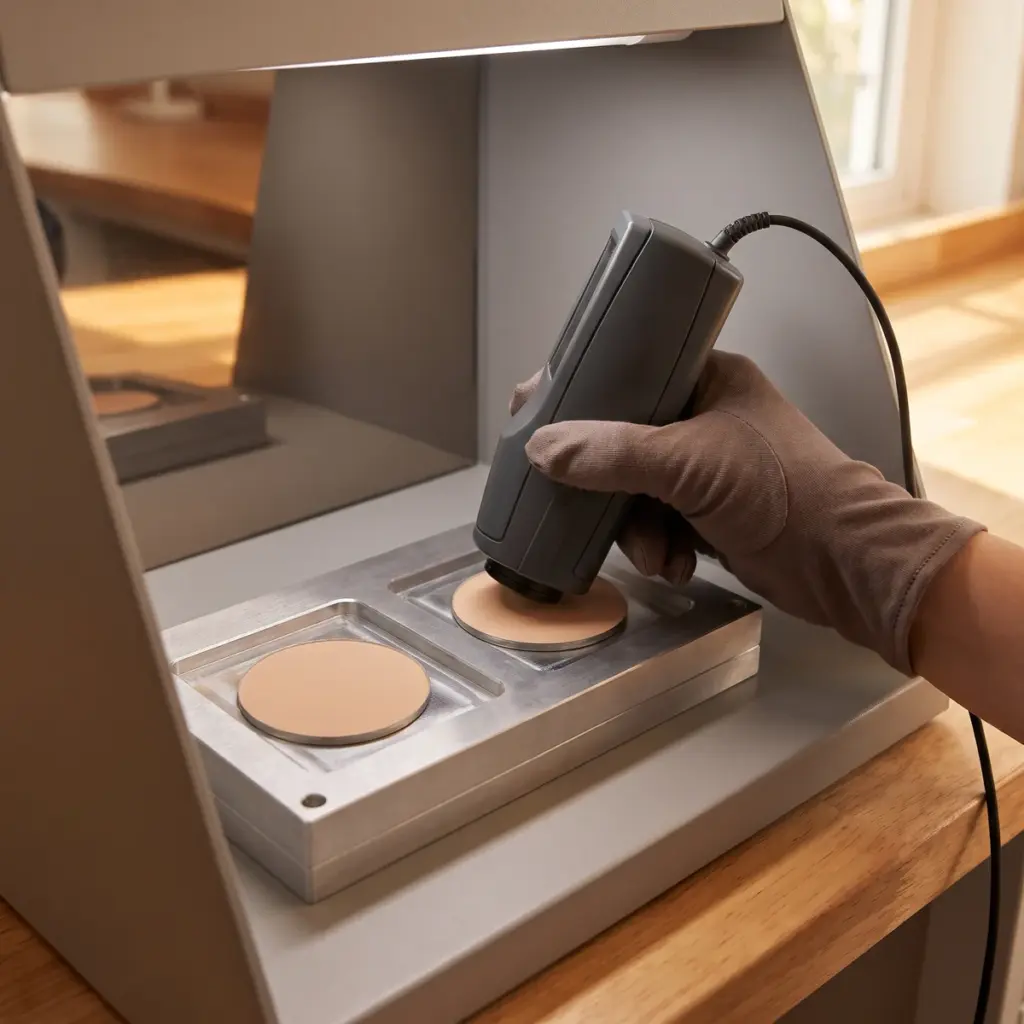
The instrument shines a controlled light on the sample and records the reflected or transmitted spectrum. Software converts that spectrum into colour coordinates for the chosen illuminant, such as the standard daylight illuminant D65, and observer angle.
CIELAB values and Delta E
L* gives lightness, a* the position between green and red and b* the position between blue and yellow. Comparing a batch with the standard gives a difference in each coordinate, which tells the formulator whether the batch is too dark, too red or too yellow, and an overall Delta E. Several Delta E formulas exist, so the report states which one was used.
Reflectance, transmission and multi-angle readings
- Reflectance for creams, foundations, powders and lipsticks
- Transmission for clear or translucent liquids and gels
- Multi-angle readings for pearlescent and metallic effect pigments
- Readings under two or more illuminants to detect metamerism
- Swatch readings over light and dark substrates for coverage and opacity
Preparing samples for repeatable readings
Film thickness, substrate, surface gloss and fill level all change the reading. The laboratory draws films with a fixed-gap applicator, presses powders to a set density or fills cells to a set depth, and keeps that preparation unchanged throughout a programme. Hair colour is measured on standard hair tresses after dyeing and rinsing.
L*, a*, b* and Delta E against the standard
You receive L*, a*, b* and Delta E for each sample against the standard, the instrument, geometry, illuminant and observer, and a pass or fail against your tolerance. Stability programmes add values at each time point and condition.
Putting instrumental color data into shade control
Colour numbers matter most at three moments: shade approval, batch release and the end of each stability interval.
Approving shades and setting tolerances
Once a shade is approved visually, measuring the master batch gives a numerical standard that travels with the formula to the manufacturer. The tolerance is then set per shade and product type, since a small shift is far more visible in a nude foundation than in a bright eyeshadow. Combine the instrument check with a visual assessment in a light booth for final release.
Tracking shade stability
Measuring samples at each stability time point and after light exposure shows whether a foundation oxidises darker, a natural colourant fades or a lipstick bleeds pigment. The data tells the formulator which pigment or antioxidant change to make, and tells packaging teams whether an opaque component is worth the cost. Where texture also changes in storage, cosmetic physicochemical testing on the same samples links the two.
Choosing a measurement provider
Ask which geometry the instrument uses, d/8 sphere or 45/0, and keep it the same as your manufacturer’s, because readings from different geometries give different numbers. For effect pigments, confirm the laboratory has a multi-angle instrument.
More in Texture Colour Testing
Texture colour testing puts numbers on how a cosmetic feels, spreads, transfers from an applicator and looks, so batches can match a reference.