Preservative Challenge Testing (PET) overview
Do you provide Preservative Challenge Testing (PET)?
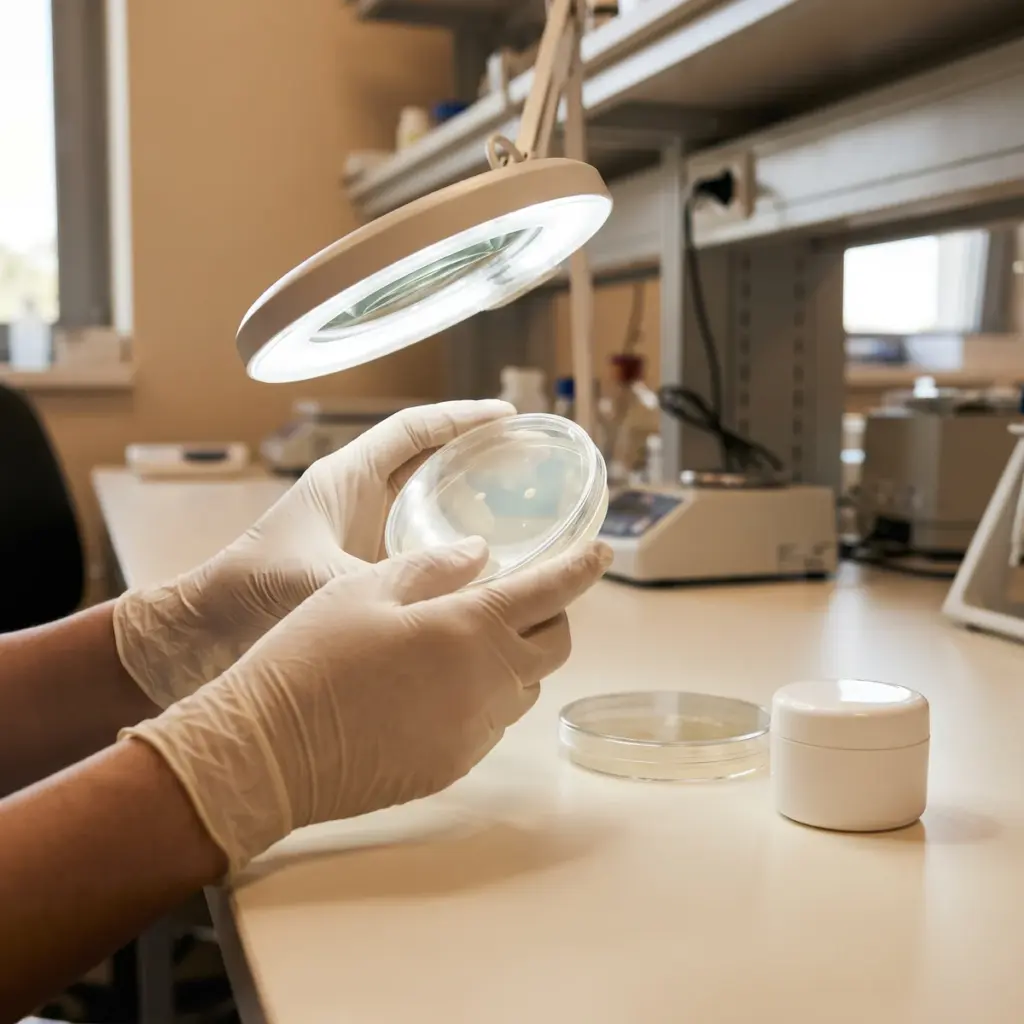
How preservative challenge testing works
The reference method for cosmetics is ISO 11930, which sets out the organisms, the inoculation, the sampling points and two levels of acceptance, criteria A and B. Pharmacopoeial methods, USP chapter 51 and Ph. Eur. 5.1.3, are used where a specification calls for them, and each has its own organisms and criteria.
Test organisms and inoculation
Under ISO 11930 the product is challenged separately with five strains:
- Pseudomonas aeruginosa
- Staphylococcus aureus
- Escherichia coli
- Candida albicans
- Aspergillus brasiliensis
Each portion of product receives a high, known count of one organism and is held at controlled room temperature in the dark.
Neutralisation check
Before the counts mean anything, the laboratory proves it can recover organisms from the product. Residual preservative carried into the counting plate would keep killing and make the product look stronger than it is. A validated neutraliser or dilution removes that effect.
Counting and results
At each sampling point the laboratory counts surviving organisms and calculates the log reduction from the inoculum. Bacteria are expected to fall faster than yeast and mould. The result for each organism is compared with the criteria, and the formula is rated as meeting criteria A, criteria B with a supporting risk rationale, or not meeting them.
Inoculum levels, counts and log reductions recorded
The report records the sample, method version, neutralisation results, inoculum levels, counts and log reductions per organism and time point, and the conclusion.
Getting useful results from preservative challenge testing
Timing and sample choice decide how much weight a PET result carries in your safety file.
When to test
Run PET on the final formula, made at the intended preservative level, and filled in the pack you will sell if possible. Testing earlier prototypes is worthwhile when you are choosing between preservative systems, since it removes weak options before stability work begins. Retest whenever a change could affect preservation: a new emulsifier, a different pH, a lower preservative level or a raw material from a new supplier. For confidence that protection lasts, test an aged sample alongside the fresh one, as part of microbiological stability during storage.
Reading criteria A and B
Criteria A is the stronger result and stands on its own in the safety file. Criteria B is acceptable when the assessor can add protective factors, such as packaging that limits contamination. If a product only reaches criteria B, or fails against one organism, a preservation system efficacy assessment works out the reason and the remedy.
ISO 11930 accreditation and matrix handling to confirm
Confirm the laboratory is accredited for ISO 11930 and keeps the reference strains it specifies. Ask how it handles difficult matrices such as powders, oils and products with high surfactant content, where neutralisation and sampling need adapting. Tell it the sample quantity you can supply and whether you also need a pharmacopoeial method for export markets.
More in Microbiological Testing
Microbiological testing checks cosmetics for contamination and proves the preservative system controls bacteria, yeast and mould during use.